It's not aging, it's the slow cancellation of the future
Welcome to 2026. Time feels more and more strange, it feels harder to parse and locate events in a coherent narrative. This past year has felt both 500 years long, and also over in moments. I've been trying to figure out why I feel more and more dislocated in time and space. It might be the piling up of years as I hurtle towards my sixth decade in this body. And there's been a feeling below the surface that tells me it's not just getting older that makes everything seem surreal.
"In conditions of digital recall, loss itself is lost" —Mark Fisher
The background thunder of geopolitics is reality-distorting, like the blatant coup in Venezuela (where they finally said the quiet part out loud: "we're here for the oil") and the threatening of invading Greenland (wtf?!??!!) The banal horror of constant police (and now ICE) shootings, gender violence, and the general financial and psychological precarity of living in the United States wears at my senses and my well-being. The hallucinations of AI and the uncanniness of deepfakes undermines my sense of reality. This definitively makes things seem a bit unhinged and unreal, on endless repeat.
I lost my ability to pay rent just before my 57th birthday. I had been slogging through manual-labor jobs for cash to make ends meet, and my aging body couldn't take it. From June until November I lived out of my Honda Fit, then I happily landed a work-trade place at an amazing farm community in southeast Washington, near the mouth of the Colombia River.
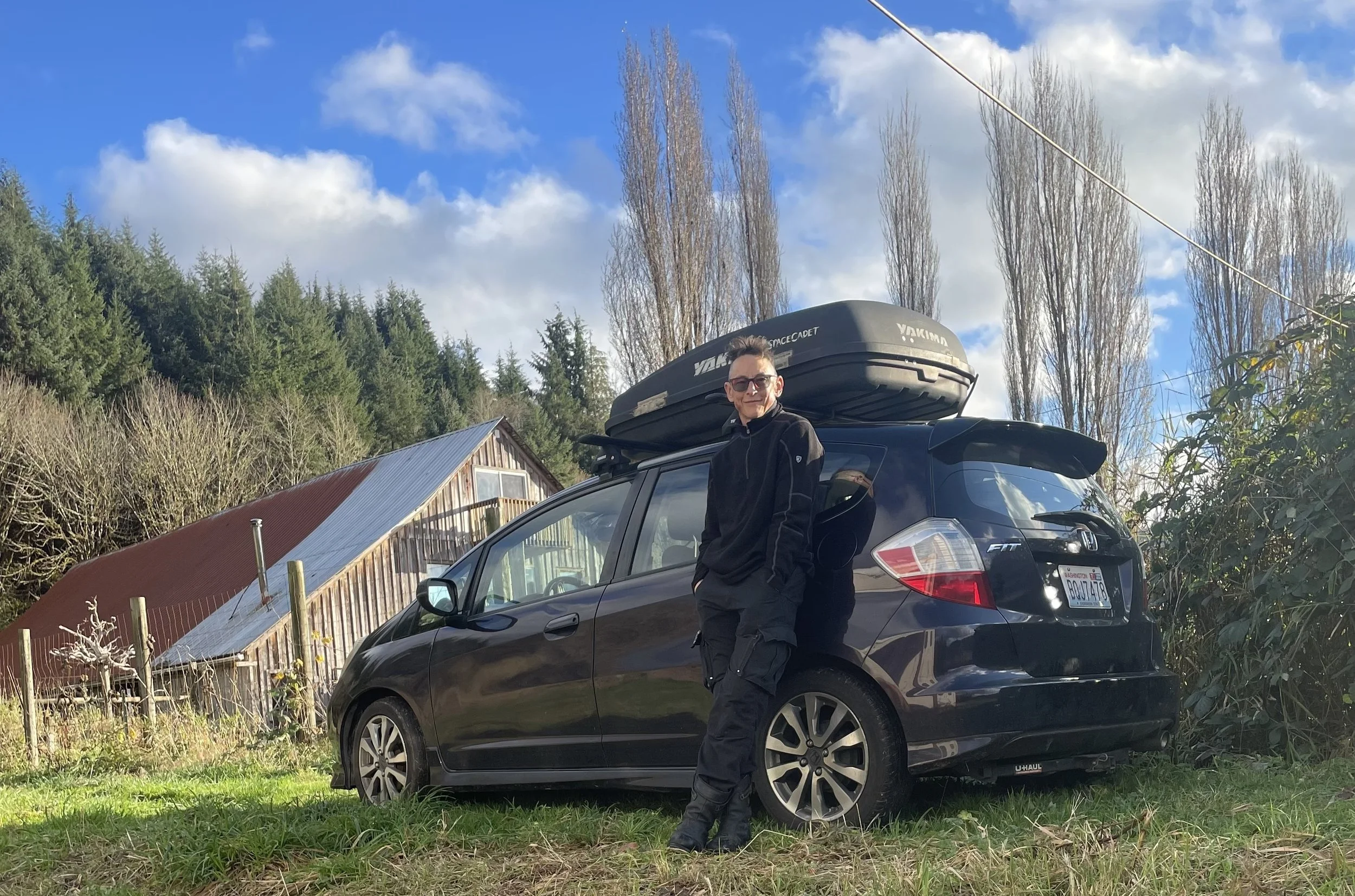
Me at the farm in SE Washington State, Nov 2025
While living out of my car, I prioritized space for a crate of books, although I found that I didn't have the cognitive capacity to go super deep. Once I landed in a place where I had my own space that I could close the door on, where I could cast myself adrift on the currents of my thoughts without feeling like I was being a bad guest, I determined to restart my once-healthy morning practice of doing journeying into the unseen realms for insight, and "feeding my brain" with engaging non-fiction.
Having to move locations and contexts every few days, for months at a time, really threw my sense of self and my foundational baseline. Do not underestimate the fundamental need of having a space that doesn't feel precarious, with a door of some kind to close and lock, that is under your power to determine how it's used. This is why addressing unaffordable or inaccessible housing options will always be near the top of my list to fight for if we want to live in a world that's worth living in. Housing First!!!

Ghosts of My Life: Writings on Depression, Hauntology and Lost Futures, by Mark Fisher (Zero Books, 2014)
One of the first books I cracked was Mark Fisher's Ghosts of My Life: Writings on Depression, Hauntology and Lost Futures. I am only partway through the first chapter because each page I turn brings a revelation. His writings are pointing to the deeper dislocation that I feel. There's a sense of wtf since this book was loaned to me by a trusted friend when I lost my housing, and I carried it around all this time while feeling lost and dislocated.
By page two, I felt like my incoherent questions were being answered, like magic. "In conditions of digital recall, loss itself is lost" — essentially, we have lost the ability to feel or imagine the future. In a digitized world, where nearly everything is available from anywhere and any time, all the time, everything's a montage. Time collapses in on itself, in hi-def 4k. I felt a sense of resonance, a sense that my brain came back online for the first time in months.
"...the 21st century is oppressed by a crushing sense of finitude and exhaustion. It doesn't feel like the future. Alternatively, it feels as if the 21st century hasn't started."
—Mark Fisher
He was a music critic first, and so uses music as a point of reference. I used to be able to hear a song and know what decade it was from; i.e., disco is not hair metal is not grunge is not jungle. It blew me away when I learned that jungle, a style of music in 90s Britain, which used dark ambient tones accented with sharp beats, invoked "a representation of historical melancholy." Being in a rave with disassociated drugged-out strangers, in an abandoned warehouse, offered a "fearful, libidinal release." It was a channel to process fear somatically in a specific chosen and limited environment, rather than experiencing the everyday fear of unaffordability, and "the existential anxiety around a new society built of market fundamentalism."
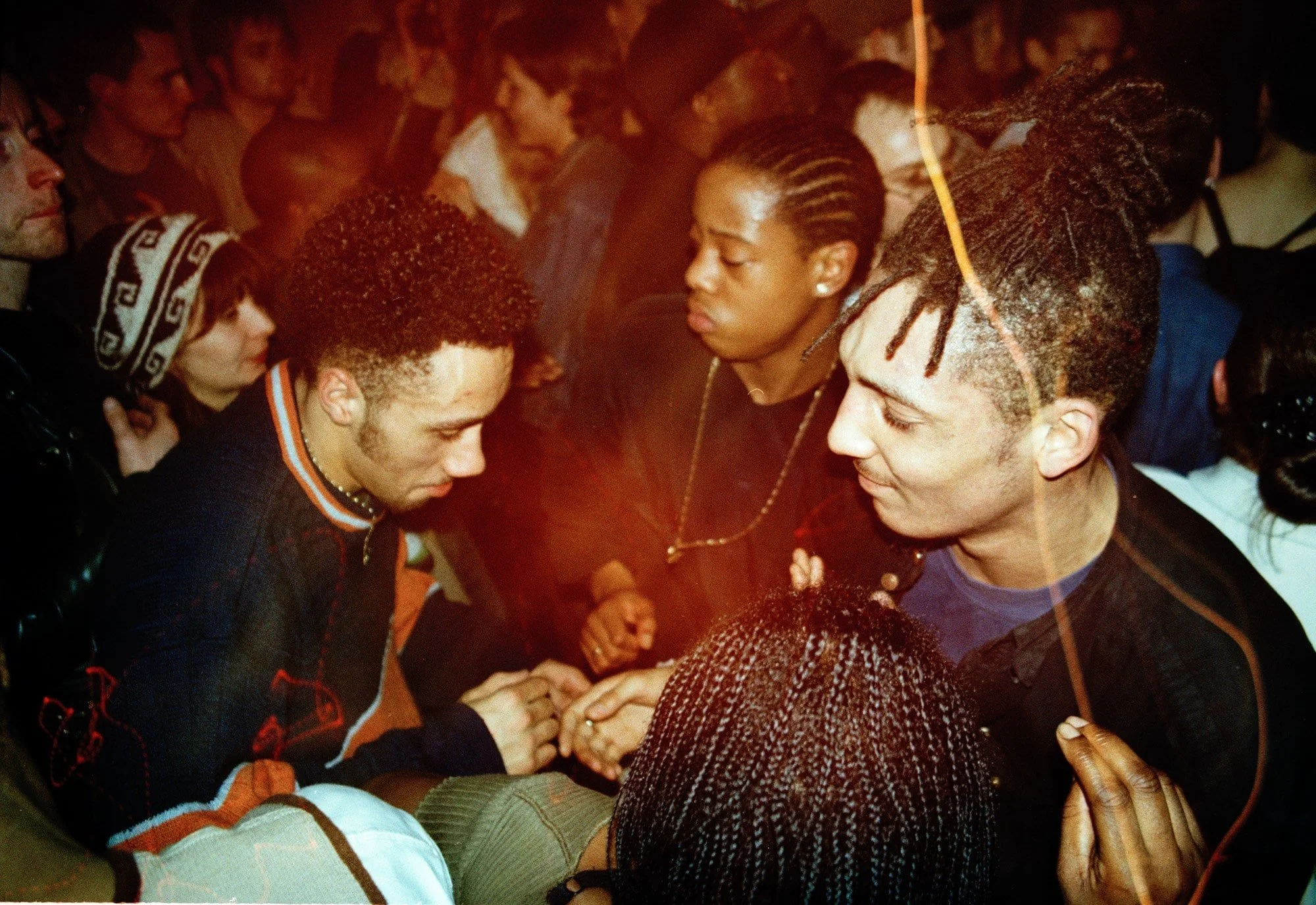
Junglist, by Eddie Otchere (AnOther Mag, July 27, 2021)
Fisher proposes that we operate in "nostalgia mode," an eternal 60s or 80s, "serenely liberated from the pressures of historical becoming." In other words, cultural forms used to be a visceral and emotional response to contemporary experience. Consider Adele: there is nothing that marks her work as retro, yet her music also doesn't really feel like it belongs to an idea of the 21st century. Her sound is "... saturated with a vague but persistent feeling of the past without recalling any specific historical moment."
The "slow cancellation of the future" has been gradual but relentless over the last 30 or 40 years—essentially my entire adult lifetime. No wonder I feel dislocated. I remember hearing punk for the first time in the early 80s and my entire universe changed. The way I saw and felt and understood the world completely broke apart and forced me to rethink everything. I can't think of any kind of music that's come even close since then; even hearing psy-trance over two decades ago made me rethink music, but didn't give me a context to rethink my whole reality.
The ghosts of our lives is the digitization of everything, and the infiltration of the internet and networked devices into every cranny of our lives. "Dyschronia," or temporal disjuncture, that results should feel uncanny... but it really doesn't. Our coherence sense of historical time has broken down from the strain of constant fragmentation and remixing. It is no longer necessary to physically move in order to access our entire cultural history. it is unmoored from felt experience.
"In recent years, everyday life has sped up, but culture has slowed down."
—Simon Reynolds
Mark Fisher famously brought the phrase: "it's easier to imagine an end to the world than an end to capitalism." Our late capitalist "culture" leaves us in a constant state of simultaneous overestimation and exhaustion. The instability of precarious underpaid work, the crush of housing costs, and the besieging of our energy and attention shoves us towards quick fixes and minimal variation. Some of this is structural. Neoliberal capitalism has deprived artists of the physical, mental, and emotional space and time to create, as it deprives their audiences the capacity to understand and appreciate it.
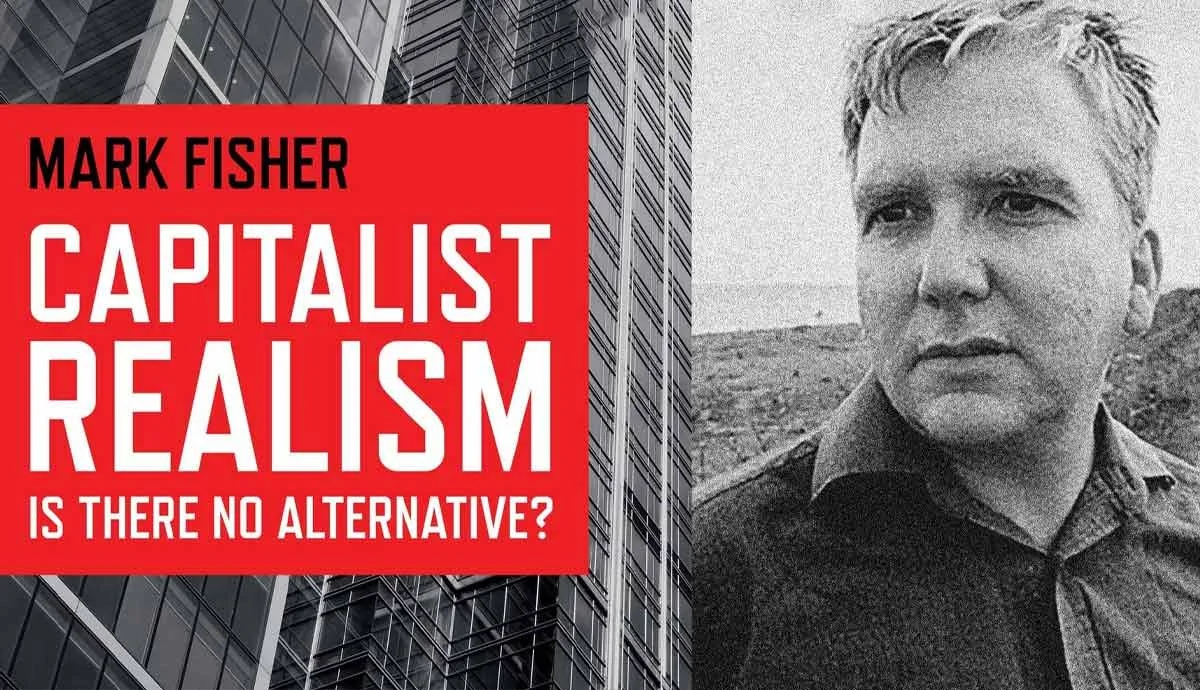
Capitalist Realism: Is There No Alternative?, by Mark Fisher (Zero Books, 2009)
In the 80s, I used to be able to live in squats, or live in cheap shared housing. In order to interact, we had to physically go somewhere, even if it was just getting up to go pick up the phone that was connected to a land line in a specific point in the house. We connected and shared ideas on porches, at punk shows, at street actions, face to face. Even into the 2000's there were cheap shared punk houses where people would come together and start bands, zines, projects of all kinds.
"To be modern is to find ourselves in an environment that promises us adventure, power, joy, growth, transformation of ourselves and the world—and, at the same time that threatens to destroy everything that we have, everything that we know, everything that we are." —Marshall Berman
I grew up with The Big Red Button, the constant and ominous threat of catastrophic nuclear war between the US and the Soviet Union that would happen any minute now. We used to do drills at grade school: all the bells would klaxon away and we'd have to crouch under those ridiculous, tiny one-piece chair-and-desk set-ups, the ones with the heavily scarred fake-wood laminate tops that lifted to expose a dubious storage compartment in the desk that smelled like stale milk and old erasers.
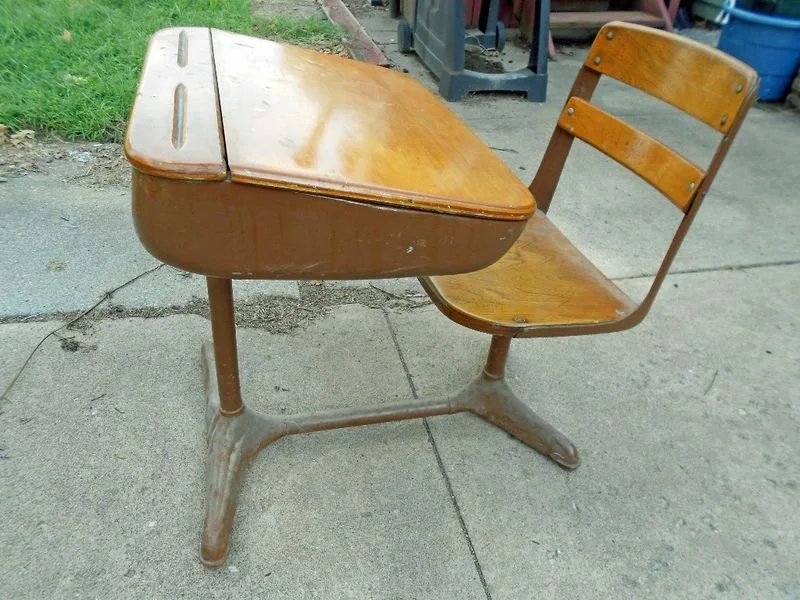
These fucking things…
Even that sort of looming cataclysm seems quaint next to the long grind of neoliberal capitalism. It was at least specific. It's hard to respond to a disaster if the disaster is made up of pretty much everything in modernity. Mark Fisher was two months younger than me. He killed himself in 2017. I want to howl: all of you stop leaving me. I feel like a fossil, a dinosaur. I don't have nearly enough shared reality with poeple who have lived these many years, from the very physical analog age into the chaotic, constant remix of the digital.
All digital, all the time, is not good for humans. I think about how on-demand everything, not just media but food and shopping and, yes, even relationships take away a little piece of our humanity each time by cutting off serendipitous interactions. How the little conversations I can have with random people while waiting in line at the grocery store actually give meaning to my life by giving me a sense of unexpected shared reality with someone I didn't know felt the world like me.
I think about Kristen Ghodsee in Everyday Utopia talking about how relationships are build on inconvenience and friction. We need places where we catch up against each other and the world to nudge or jolt us into new ways of feeling and understanding. We need context to understand our place in the world. "Depression, Hauntology and Lost Futures" seems matter-of-fact as a subtitle for our times. Find and amplify the friction in your day-to-day, and feel more grounded in the here and now.